
.avif)


Leading today can be a double-edged sword. On the one hand, leaders have access to more tools and resources to be better leaders. On the other hand, they are operating in a time that is defined by uncertainty, not to mention the constant and rapid changes and disruptions to the market due to different reasons, be it market volatility, political turmoil or fast technological advancement.
Most leaders are groomed for a Newtonian world: A place of predictable cause-and-effect where, if you apply enough expertise, you can reach a definitive solution. We call this "ordered thinking” or unlocking technical problems. But we no longer live in an ordered world; we operate in a state of dynamic non-equilibrium. It is a world of permanent flux where the goal is not to reach a "new normal," but to survive a state of serial disruption.
How to Pivot in Times of Uncertainty
Managing yourself as a leader during uncertain times is where the sailing starts and facing the wind ahead is what builds your capacity.
Brian Chesky of AirBnB shared that one of the biggest obstacles in dealing with an uncertainty was his own thoughts. He experienced this during the initial outbreak of COVID in 2020, one of biggest examples of uncertainty of our time. The hardest thing to manage in a crisis isn’t your company—it’s your own thoughts. As a leader, you could think all is doomed. You can ask, ‘Why me?’ You can get paralysed. Or, you can tell yourself, ‘This is my defining moment, and it will leave indelible marks,” he said.
1. Your Problem is Probably "Wicked": You Can't Solve It Once and For All
In more predictable times, leaders often approached challenges as if they were “tame” problems: clearly defined and ultimately solvable. But many of today’s leadership challenges are different. They are what design and planning theorists Horst Rittel and Melvin Webber called “wicked problems”, which are problems that are complex, interconnected, and resistant to definitive solutions. In their 1973 paper, they argued that wicked problems have a “no stopping rule.” This means that you do not stop because you have found the true and right answer; you stop because you have reached your limit of time, money, alignment, or momentum.
For leaders, the implication is profound. In times of uncertainty, the job is not to find a perfect solution. It is to make sound judgments, communicate clearly, learn quickly, and keep adapting as conditions change. As Rittel and Webber put it: “Social problems are never solved. At best they are only re-solved—over and over again.”
2. Stop Treating Complicated like Complex and Complex like Predictable
The Cynefin Framework offers leaders a critical distinction: Complicated is not the same as complex. In a complicated environment, expertise matters. Cause and effect can be understood through analysis, and good practice can be applied with confidence.
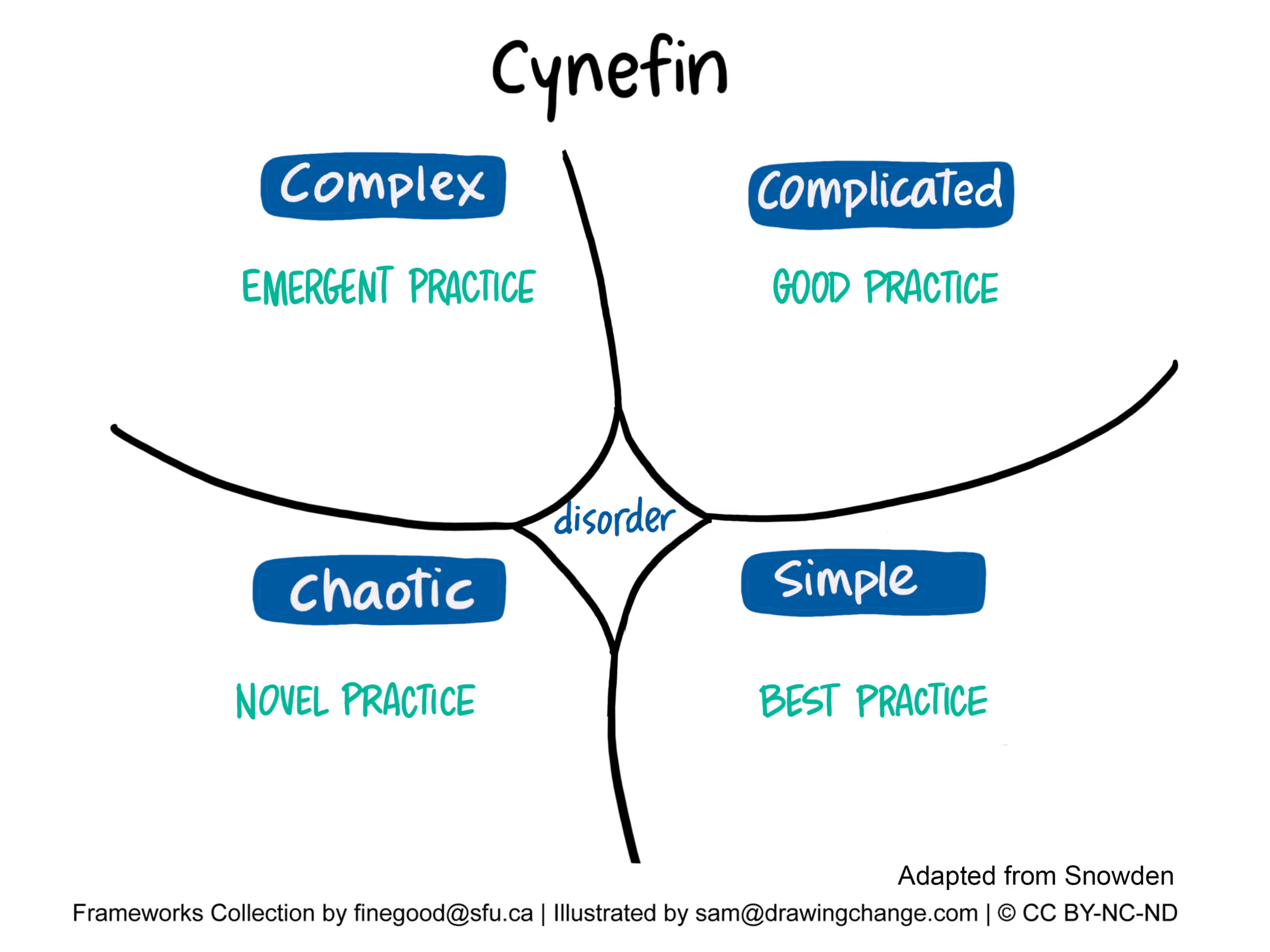
In a complex environment, however, patterns only emerge over time, and often only in hindsight. What worked before may not work again in the same way. That is where many leaders fall into the expert trap: they apply yesterday’s answers to a situation that is no longer predictable.
This framework is especially useful because it warns against complacency. The boundary between the obvious or simple domain and the chaotic one is often described as a cliff: when leaders become overconfident in established best practices, they can miss weak signals, suppress variation, and fail to notice that the context has changed. By the time the old playbook stops working, the organisation may already be in crisis.
In complex conditions, leadership is less about declaring the answer and more about creating the conditions for learning. This means:
- Probing with safe-to-fail experiments,
- Sensing for emerging patterns, and
- Responding by amplifying what works and dampening what does not.
The goal is not certainty at the outset, but disciplined adaptation.
3. The Discipline of the Pause: Why Restraint is an Act of Leadership
Modern leadership culture over-indexes on what might be called "positive capability”, which is the drive to decide and act quickly to show control. In stable environments, this proves useful and successful but in uncertainty, the impulse to act can become a defensive reaction, a form of self-protection. It is a way for a leader to quell their own anxiety and avoid the discomfort of not yet having the answer.
That is why leaders in uncertain times need a different discipline. What poet John Keats called “negative capability”, which is the capacity to remain in “uncertainties, mysteries, doubts, without any irritable reaching after fact and reason.” In leadership terms, this is not passivity. It is the ability to hold ambiguity without collapsing into false certainty. It is the discipline to pause, interpret, and make sense before forcing resolution.
In practice, the discipline of the pause means slowing down just enough to reframe what is happening, test assumptions, read weak signals, and create conversations that allow a shared understanding to emerge. It means preparing people for action without pretending that every action will be right.
The paradox is that this kind of restraint often produces better action faster. When leaders do not rush to perform certainty, they are better able to see what the moment requires and move with greater clarity, humility, and adaptability once the pattern begins to emerge.
4. Get Out of the Game and Onto the Balcony
If the first discipline of leadership in uncertainty is the pause, the second is perspective. Leaders cannot make sense of a wicked, complex situation if they are completely consumed by it. Pioneering Harvard scholars and co-founders of Cambridge Leadership Associates Ronald Heifetz and Marty Linsky describe this as the ability to move between the “dance floor and the balcony”: to stay close enough to the action to understand its pressures, while stepping back far enough to see the larger pattern.
Think of Magic Johnson on the Lakers' court or Bobby Orr on the ice. While other players were captured by the rapid motion and the roar of the crowd, these greats could see the entire game as if from a press box. They saw the patterns: Who was open for a pass, how the defense was shifting, and allowed those observations to guide their actions.
Most leaders struggle here because they are pulled into the immediacy of events, but adaptive leadership requires more than presence; it requires interpretation. From the balcony, a leader begins to see the bigger picture of what is really happening and adjust accordingly.
That balcony view matters because uncertain times do not simply demand new action. They demand better judgment and require leaders to distinguish between what is essential and must be conserved, and what is not working anymore and holding everyone back. In uncertainty, leadership is not about standing above the rest of the team and being detached from them. It is about moving repeatedly between the balcony and dance floor and about participation and reflection so that action is informed by pattern, not just pressure.
5. The Change You Need May Be the Change You Resist
Stepping onto the balcony is not only about seeing the system more clearly. It is also about seeing yourself more clearly. One reason change takes longer during uncertain times is that leaders often focus on external behaviour while ignoring the internal commitments that keep them tied to the status quo. Harvard researchers Robert Kegan and Lisa Lahey call this “Immunity to Change,” which is the hidden mental system that protects us from perceived danger, even when it blocks the very transformation we say we want.
A leader may say they want a more innovative or adaptive culture. But beneath that aspiration may exist a competing fear not to appear uninformed, not to lose authority, not to make mistakes in public, not to disappoint people who trusted the old model, to name a few. These are rarely visible on the surface, which is why Kegan and Lahey describe the work almost as a “mental X-ray.” Until those hidden assumptions are surfaced, leaders often keep demanding a form of change that their own behaviour quietly resists.
This is why adaptive leadership is personally demanding. It is not just strategic work; it is identity work. In uncertain times, leaders are often asked to let go of the habits and expertise that once made them successful. That is what may make adaptation feel like a daunting challenge. The challenge is not simply to lead others into uncertainty, but to notice the ways in which you are still trying to protect yourself from it.
6. Lead Like a Thermostat, Not a Light Switch
Once leaders can read the system and recognise their own resistance, the next task is to regulate the environment in which change happens. Adaptive leadership is not about switching change on and off like a light switch. It is closer to the work of a thermostat: adjusting the level of tension so that people feel enough discomfort to confront reality, but not so much that they shut down, panic, or turn on one another. Heifetz and his colleagues describe this as “keeping people in a productive zone of disequilibrium.” Leaders must challenge familiar stories, surface uncomfortable truths, and protect voices that might otherwise be ignored.
On the flip side, leaders need to know and be aware of when to release the steam. If the heat stays too high for too long, organisations stop learning and start defending themselves. People become overwhelmed, conflict becomes personalised, and energy that could have gone into adaptation gets diverted into blame, denial, or exhaustion. In this case, the leader’s role is not to eliminate distress but to contain it to create enough steadiness, honesty, and trust that people can stay in the work without being consumed by it.
In uncertain times, organisations do not need false reassurance. They need leaders who can hold the temperature at a level where truth can be spoken, innovation can continue, and learning can happen.
7. Accept the Losses
This may be the hardest truth of all: Adaptive change always involves loss. People are not only being asked to try something new. They are often asked to give up something old, like a routine, a competence, or a habit that has been working for them for years. This is why resistance is so often emotional rather than rational. People are not merely resisting change, they are anticipating what change will cost them.
Leaders must therefore do more than champion the future. They must acknowledge the losses that come with it. They must name what is ending, recognise the discomfort people feel, and resist the temptation to oversell transformation as a painless win.
Uncertain times can indeed build resilience, creativity, and strength but only if leaders accept that progress may come with missteps, sacrifices, and the surrender of once-valued certainties. Adaptive leadership is not loss-free leadership. It is leadership mature enough to work with loss rather than deny it.
The Courage Not to Know
Adaptive leadership is not a blueprint. It is an improvisational discipline practiced in conditions where there are constant moving pieces. It requires the courage to admit that your past expertise may be the very thing keeping you from adapting to the future.
That is why leading in uncertainty requires a different kind of courage. Not the performance of certainty, but the courage to pause.
The courage to get onto the balcony.
The courage to examine your own immunity to change.
The courage to regulate distress without either inflaming it or suppressing it.
And the courage to accept that meaningful adaptation will almost always involve loss.
The temptation in times of uncertainty is to reach for the old playbook and call it decisiveness. But the deeper task is to help people navigate toward a future that is not yet shaped. In that sense, uncertainty is no longer an interruption to leadership. It is increasingly the condition in which leadership must be practiced.
The Insights in a Nutshell
- Many of the challenges leaders face today are not technical problems to be solved, but “wicked” problems to be continually navigated.
- They are complex rather than merely complicated, which means they do not yield to expertise or best practices alone. They need something more difficult: the humility to pause and suppress the need to act immediately.
- That is why leadership today is not simply about action. It is about perspective, i.e., stepping off the dance floor and onto the balcony to see the wider picture, the hidden patterns, and the losses people are being asked to absorb.
- It is also about honesty: Recognising that resistance to change is not only organisational but can also be personal. Leaders must confront their own reluctance to embrace the change and the competing commitments that can quietly keep the old world in place.
- Above all, leadership in uncertainty is about pace and regulation. It is knowing how to turn up the heat without creating panic, how to release pressure without losing momentum, and how to keep people in the productive tension where learning, adaptation, and renewal can happen.
In the end, leadership in uncertain times is not about having the perfect answer. It is about helping people face reality, stay anchored in what matters, and keep moving toward a future that is still taking shape.